
A Liquid Army
Reflections inspired by Andrea Gibson

You can listen to me read this here:
If I do nothing else today—this week—other than share Andrea Gibson ’s Calais High School commencement address, I will have done so much good. So that’s where I’m starting:

Please take 17 minutes of your day to listen—really listen—to what Andrea shares. As you listen, join me in imagining how beautiful, how kind, how love-filled our world would be if every high school graduate listened to THIS message as they accepted their diplomas, crossing the threshold into the boundless opportunity and responsibility that comes with being a human in this messy and tender and fraught and challenging and full and gorgeous world. Let Andrea’s words — the otters and the whales and the caterpillars and lumberjacks — open your heart. Then, share it with someone(s) you love. With someone(s) with whom you haven’t connected in too long. Send it as an olive branch to someone(s) with whom you feel estranged. To someone(s) who might need to hear this message (i.e. everyone).
After that, if you still have it in you, I’d love to have you return to spend some of your precious open-hearted moments with me. My writing today is inspired by Andrea.
A Liquid Army
You’ve heard of the oft-referenced fight or flight response in which we put up our dukes or high tail it in the opposite direction depending on our near-instantaneous, instinctual, and statistical assessment of a threat and our odds.
That choice set—to fight or to fly—has always seemed incomplete to me. Too binary.
In my life, I have rarely fought (though my brother may disagree). Also, I’m not very fast and I have no wings. I have, rather, almost always responded to threats and opportunities alike by gathering.
In RebeccaSolnit ’s book, The Mother of All Questions, she writes that ‘fight or flight’ is just one response to threat. Solnit shares a lesser-known paradigm: “tend and befriend.” This is a response to a threat in which people run toward others, toward community, toward connection. Toward togetherness.
When I read this, I finally had words to describe something instinctual in me.
I love collectives. Collectives of people. Collectives of animals. Collective leadership. Collective organizing. Collective action. When I don’t know what to do, I always find that gathering with others to explore, talk, listen, and learn—to be together—is a next right step. My thinking on this matter is simple enough: if nothing else, tending and befriending is something I know how to do and it always makes me feel better.
Among collective things I love are many of the names we humans have coined for groups of animals and plants. I love them for their whimsy and aptness. For their evocativeness. A Cackle of Hyenas. A Bloat of Hippos. A Parliament of Owls. A Cauldron of Bats. A Celebration of Polar Bears. A Murmuration of Starlings. A MURMURATION! I like to all-caps shout that one, not whisper. Anyone who has watched A Murmuration knows it is absolutely something to shout home about.
A Towering of Redwoods. A Trembling of Aspens.
A Kaleidoscope of Butterflies.
The other day, my daughter, Nora (age 6), biked while I ran through the forest. We passed a pond where our family went for a walk a few weekends before. She lifted one hand from her handlebars, pointed to the pond, and said,
“That’s the butterfly pond!” and, “Look! Just one hand!”
At this pond, Nora and her older sister Clara (8) tried to get one of the Blue Swallowtails, each lapping mud with their curious proboscises (probosci? the plural of this noun evades me), to land on their fingers.
“Oh yeah! I remember!” I said.
Although no butterflies paused on their palms, the soul birds1 instead captured Nora and Clara’s attention, stretching their focus toward magic in the way children still know by heart.
Andrea Gibson wrote,
“Everyone loves butterflies, but I have always trusted caterpillars more. I trust the ones who know: they are not done growing.
Andrea peeled back the onion-skin of metamorphosis, exposing for all to feel this truth: before emerging as a butterfly, before joining the blossoming fractal of a Kaleidoscope, caterpillars in a chrysalis become completely liquid.
A group of Caterpillars is called An Army.

At first glance, this one seems to have missed the mark in our whimsical-musical-meaningful names for creature collectives.
There’s nothing remotely militaristic about melting before transforming.
What uniformed, armed soldier would liquify to win the war? Which general would shed, as Andrea calls them, “chrysalis tears” on the battlefield?
And…what if this type of trust and learning and growth is exactly what this moment calls for?
On this subject, I have good news. A deeper etymological dive into the word army makes space through which we can flow.
Army definition number two is ‘a great multitude.’ Definition three is ‘a body of persons organized to advance a cause.’
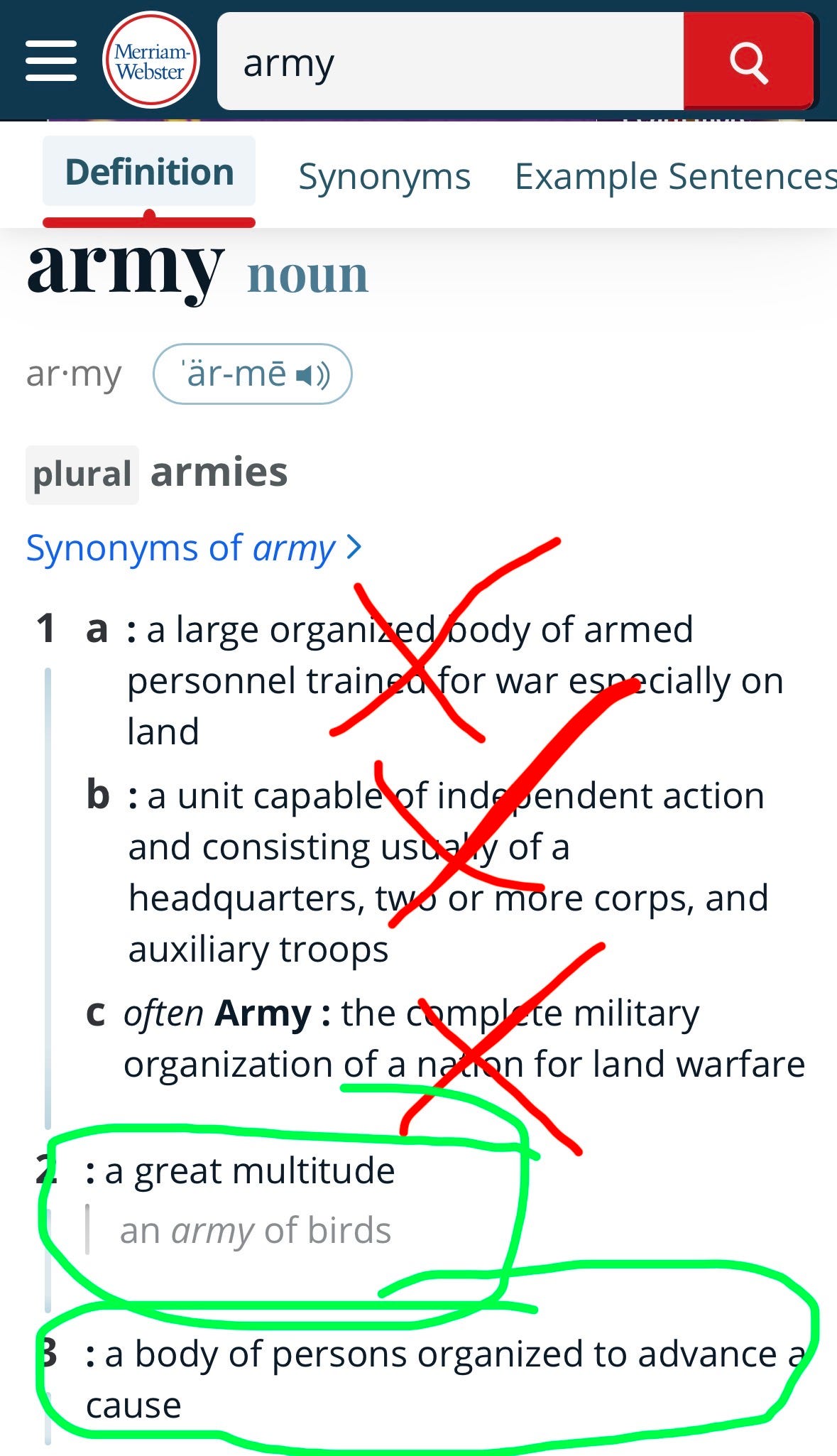
I believe the confluence of these two definitions, where we gather in great multitudes with others to advance a cause—where we tend and befriend—is exactly why a group of Caterpillars is called An Army. Together, our soft and gooey and vulnerable learning-growing Army can make possible our collective metamorphosis into a Kaleidoscope world.
❤️,
Becca
I learned the term “soul bird” for butterfly from Dr. Clarissa Pinkola Estés in Women Who Run With the Wolves.
We need our collectives now, here, more than ever.